


Listening Past the Noise
Cultivating Emotional Intelligence & Communication in Chaotic Classrooms

Still Standing
Personal Healing from Trauma and Deprofessionalization While Teaching at the Fault Line of Ideological Tension
&
Trauma-Informed Teaching Beyond the Buzzwords


Justice-Oriented Teaching in the New Age of Teaching
Sociopolitical Consciousness and the Fight for Relevance
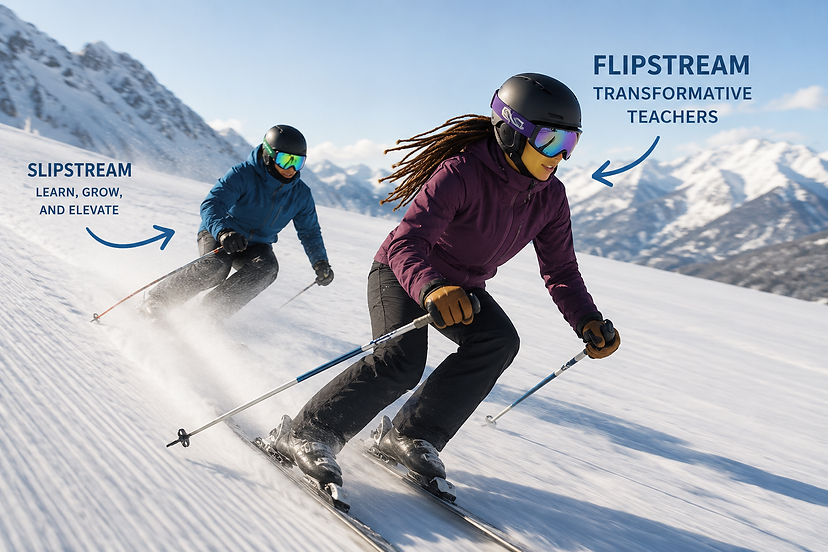
Flipstream, born from Dr. Marinda’s observations of highly effective public school K–12 teachers, draws on downhill skiing, a sport in which a person descends snow-covered slopes on long, flat runners attached to their boots. Skiing requires terrain-reading and balance-finding at high speeds, and people often learn this through shadow skiing and slipstreaming. In shadow skiing, a less experienced skier follows a more seasoned one. The trailing skier stays close enough to study the timing of turns and the subtle decisions that resist easy explanation but are unmistakable in real time. Rather than narrating or correcting, the lead skier simply skis well, and that competence becomes legible through proximity.
Slipstreaming goes one step further, one skier dropping in just behind another, riding the channel of reduced resistance created ahead. Here, the skier in front quite literally alters the conditions of movement by reducing drag. The trailing skier remains responsible for balance and judgment but mistakes are less costly. Over time, if this relationship works as it should, the goal is not permanent following or, more simply, dependency. On the contrary, the skier behind begins to read and feel out the conditions of the terrain for themselves and is able to trust their own perception. It is from this progression that Flipstream emerges, a term that names this form of practice as it applies in schools.
Welcome to the Flipstream.